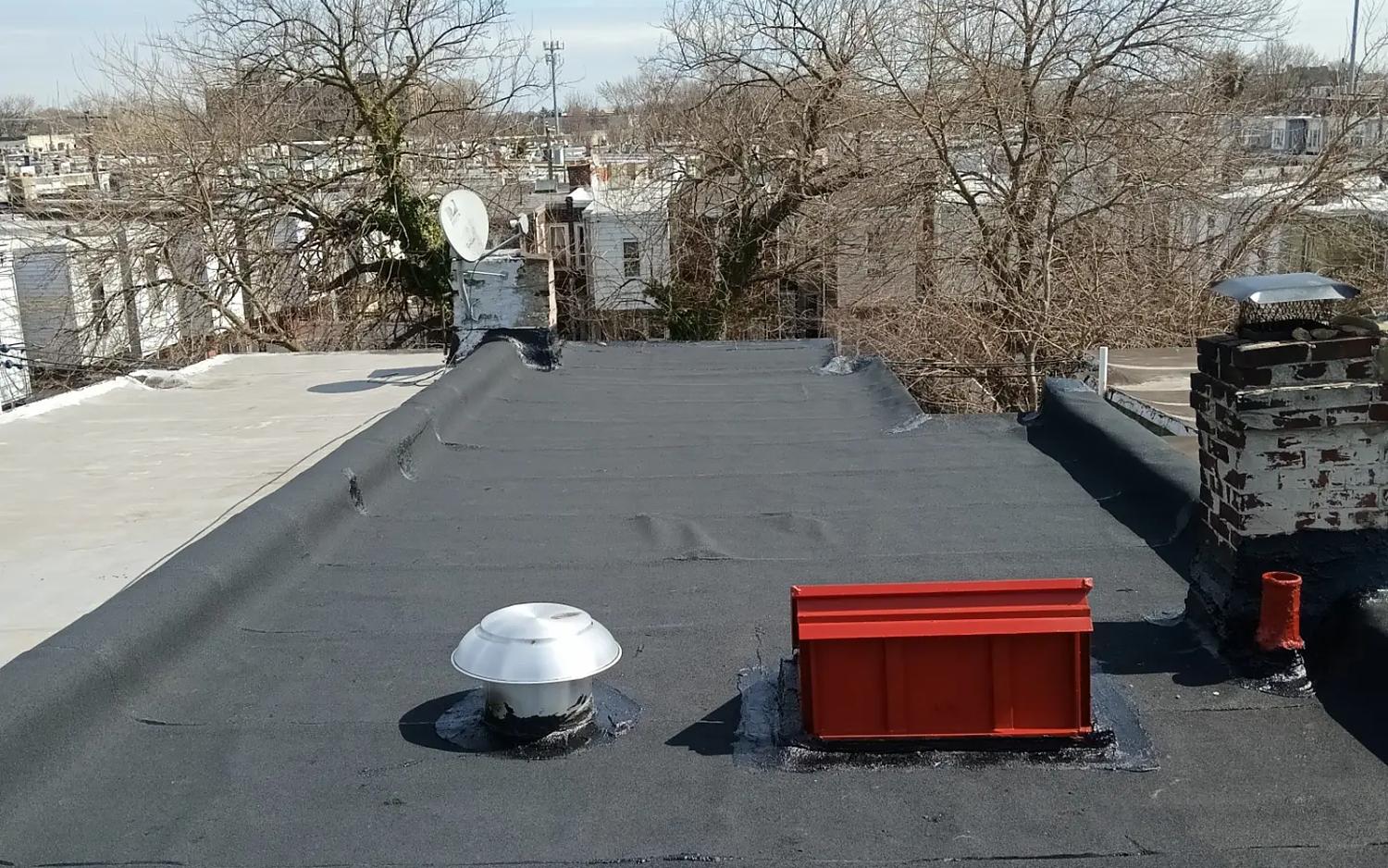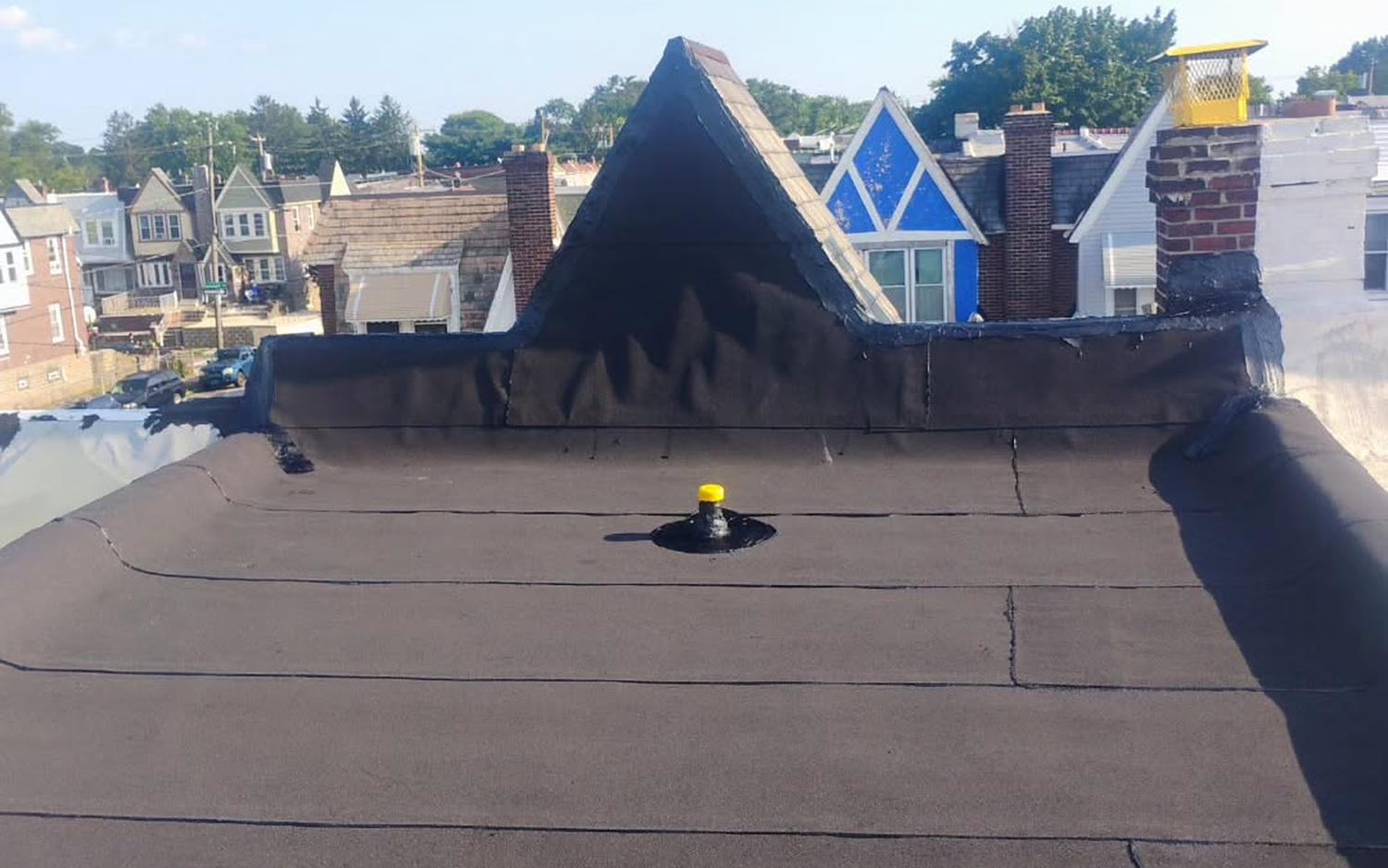
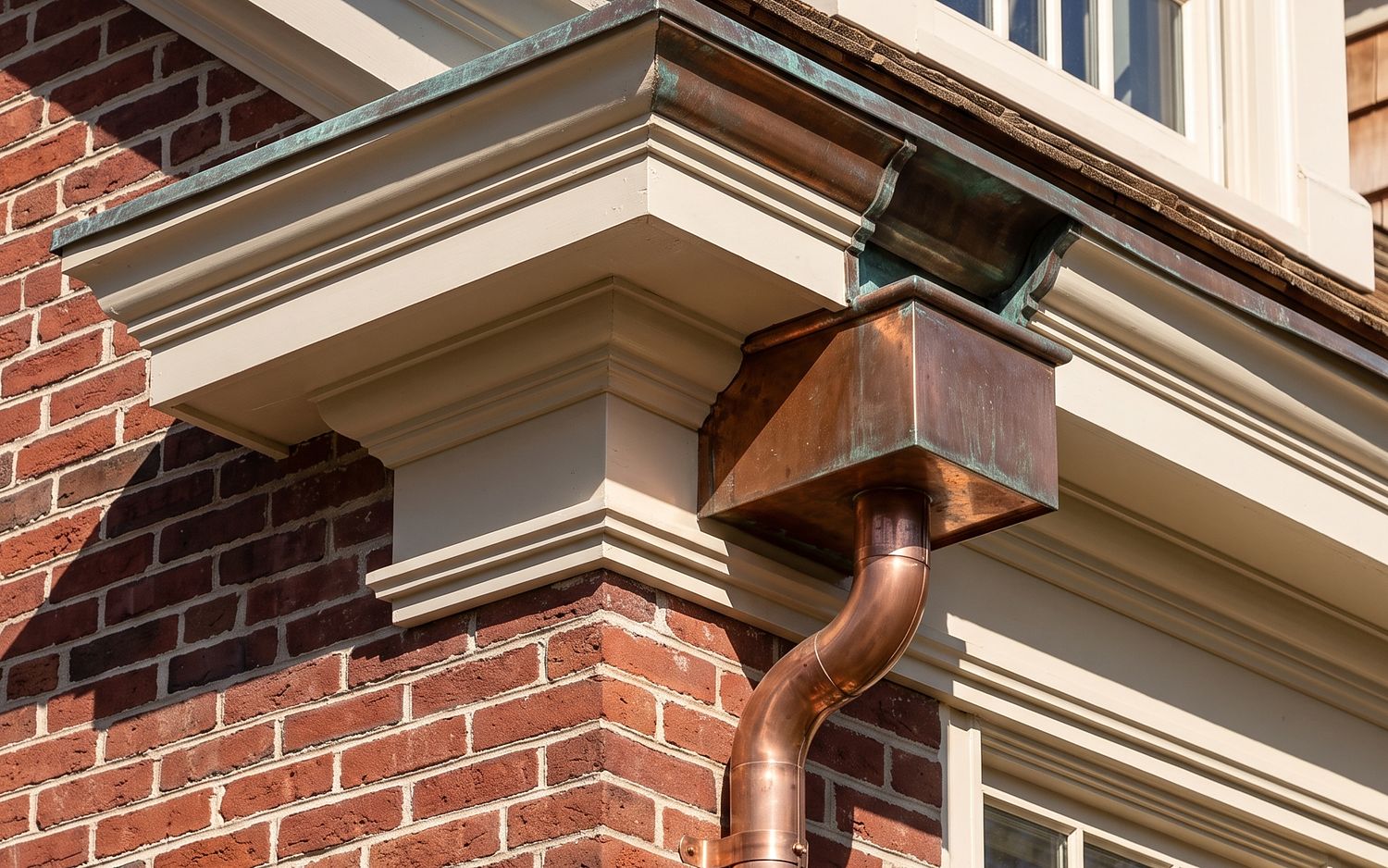
If your house was built before about 1930 and the roof edge looks suspiciously clean — no gutter hanging off the front, just a nice moulded cornice — you almost certainly have box gutters. Philadelphia is full of them, and they are the single most misdiagnosed source of water damage we see.
What they actually are
A box gutter, also called a Yankee gutter or a standing gutter, is a wooden trough built into the structure of the roof edge itself and then lined with metal or membrane. It is not hung off the fascia the way a modern gutter is. It is part of the roof, and it is usually hidden behind the cornice so you cannot see it from the street at all.
The advantages are real: enormous capacity, and a clean roofline with nothing bolted to the front of the house. On a Victorian or a stone twin they are the correct detail, and a sound one can be relined rather than rebuilt.
Why the failure is so easy to miss
Here is the whole problem in one sentence. When a hung gutter fails, the water runs down the outside of the house and you see it. When a box gutter fails, the water runs into the inside of the wall, and you do not.
A hung gutter fails in public. A box gutter fails in private, into the cornice, the wall and the joist ends — for years before anybody notices.
By the time it shows up as a stain on the top-floor wall, water has usually been getting into the structure for several seasons. The cornice is what tends to go first, because it is the timber closest to the leak, and cornice repair is joinery as much as roofing.
The tell-tales, in the order they appear
- Paint blistering or peeling on the fascia and cornice, high up, in one specific spot
- A stain or damp patch on the top-floor wall — not the ceiling
- Ice building up along the roof edge in a way the rest of the block does not get
- Plaster going soft or crumbly in the top corner of an upstairs room
- Sagging or opening joints in the decorative cornice under the roof edge
- Water appearing indoors during a long steady rain but not during a short heavy one — the classic sign of a trough that is overflowing rather than a hole in the roof
Why they fail
Almost always one of four things, and only one of them is the lining:
- The lining has split or corroded. Old metal linings work-harden and crack at the seams, particularly where the trough changes direction.
- Debris. A box gutter is a wide flat trough at the bottom of a roof. Everything the roof sheds ends up in it, and unlike a K-style it has no shape that helps it clear itself.
- The pitch has gone. The trough relies on a very slight fall toward the outlet. When the timber underneath sags, the fall reverses and water sits.
- Somebody tarred it. This is the one that makes us wince. Roofing cement smeared into a box gutter dries hard, cracks in the first freeze, and traps water under the patch where nobody can see it.
Relining versus rebuilding, and how to tell which you need
If the timber trough underneath is sound, the job is a reline: strip the failed lining out, make good, and put a new membrane or metal lining in with proper terminations at both ends and a correctly formed outlet. That is skilled work, but it is not a rebuild, and it is a fraction of the cost.
If the trough itself has rotted — and after years of a slow leak it often has — then the carpentry has to come first. There is no lining you can put into rotten wood that will hold, and anybody offering to do one is selling you two years.
The honest answer is that you cannot tell which one you are looking at from the ground, and quite often you cannot tell from the roof either until the old lining is out. We say so on the estimate rather than discovering it on the day and handing you a different number.
What we do not recommend
Ripping a box gutter out and hanging a modern K-style off the fascia instead. It is occasionally the right call on a house where the cornice is already gone, but on an intact period house it is the wrong detail, it looks wrong from the street, and it usually means cutting into original timber that was doing its job perfectly well.
If your top-floor wall is damp
Before you let anybody sell you a full roof, get the box gutter looked at. On the older stock in Germantown, Mount Airy, Port Richmond, Norristown and the Old York Road corridor, the box gutter is the first place we look when a leak shows on the wall rather than the ceiling — and it is very often the whole answer.